American football is one of the world’s most famous and exciting sports. However, for new viewers, it can be confusing. Whether you’re a total newbie or need to refresh your knowledge on a few American football knowledge, this guide can help you better understand this game.
The Bottom Line: Outscoring the Opponent
Like in many sports, football teams aim to outscore their opponents. To score a point, players must get the ball across the goal line into the end zone.
Players have a 120-yard, long, and rectangular field to run across, which can be made of grass or turf in a standard setting. However, the field of play is exactly 100 yards long, with two 10-yard scoring end zones on both ends.
A team gets six points when a football crosses the goal line, in what’s also called a touchdown. After a touchdown, teams can get additional points in a two-point conversion by scoring a touchdown again from the 3-yard line.
Where a team cannot score a touchdown in four downs, they can kick a field goal via the end zone, which is worth three points. Elsewhere, teams can score points (while on defense) by tackling an opposing athlete in their end zone. If the defense successfully tackles the offense in their own end zone, it is known as a safety, and football rewards the defense with two points.
Having understood the basic goal of American football, virtually anyone can try out a sportsbook from Casino Poland. A good demo or trial could involve predicting the end score line or other metrics surrounding the order of play.
Order of Play
The game begins with a kickoff, whether with special teams lines from both sides. If your team kicked the ball off, they’d immediately play on defense while the receiving team gets on offense. The offensive side tries to run the ball down the field as far as possible before being stopped (either via tackles or forced out-of-bounds runs) by the kicking side.
The receiving team may also get a touchback, which occurs when they catch the ball in the end zone and take a knee, or when the ball is kicked beyond the end zone. After receiving a touchback, the offense automatically begins its drive down the field at the 25-yard line.
An offensive side has four plays (or chances) to gain 10 yards. These chances are also called downs. As soon as they gain 10 yards, even if they’re on third down, they reset the downs so they have another four chances to gain another 10 yards.
Just before each down, teams line up on opposing sides of the line of scrimmage, an imaginary line that separates offense from defense. The down begins when the center snaps the ball to a quarterback, who then chooses between handing off the ball for a running play to gain yards or throwing it for a teammate’s catch, who can run it further toward the end zone.
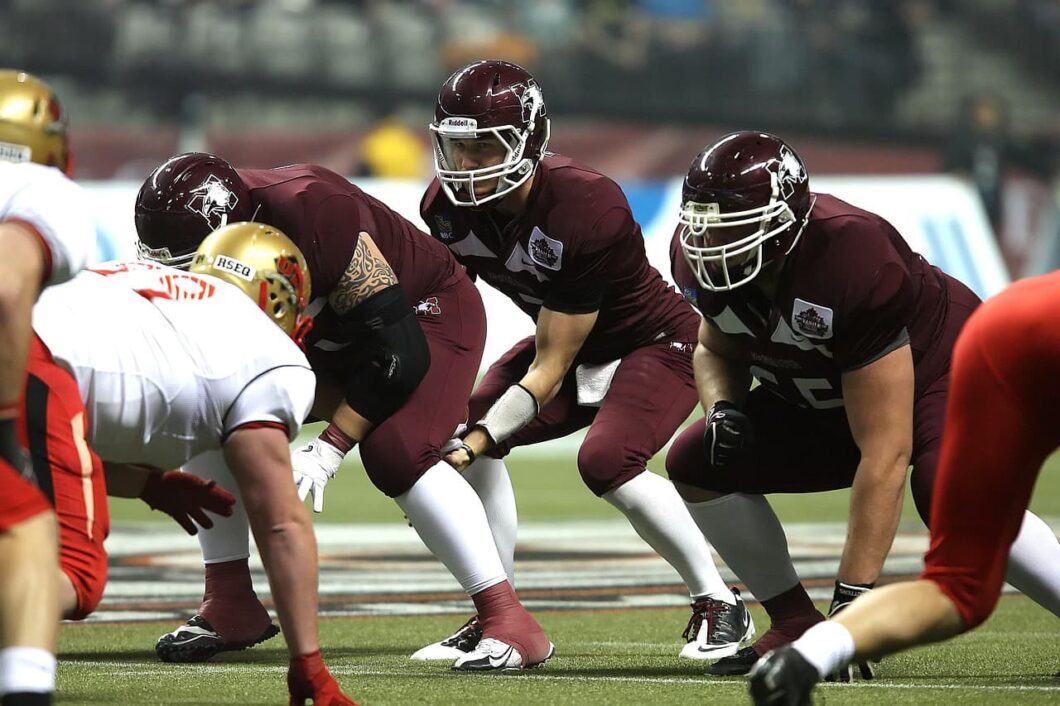
An American football defense has one goal: to stop the offense from getting 10 yards in four downs. To achieve this, they may tackle ball carriers, intercept passes, or break up passes. Also, they can cause the offense to drop the ball, picking it up to resume an offensive role that may peak in a touchdown.
One of three things can happen if the defense succeeds in ensuring the offense never gains 10 yards: The offense can punt the ball away on fourth down to the other team, or choose to go for it and try to get the remaining yardage in a passing or running play.
However, if they fail to get the remaining yardage on the latest attempt, they forfeit the ball, and the other team begins from the ball’s location.
The third possibility on the fourth down is for the offense to consider kicking a field goal if they’re close enough to the end zone for three points (against potential six points from a touchdown).
Balls change possession after the offensive team:
- Attempts a field goal
- Fails to convert (i.e., earn a first down or score) on the fourth down
- Scores a touchdown (and attempts the extra point or two-point conversion)
The team with more points at the end of the game wins. If there is a tie at the end of the fourth quarter, overtime begins. The guiding rules in overtime vary at different levels and in various leagues.
Summary
Although each quarter consists of 15 minutes, games usually last up to three hours, with frequent time stoppages due to timeouts, breaks in-between quarters, pauses in-between possessions, and more. With 22 on-field players vying for the ball in a high-contact game, there’s little surprise that this sport has become an easy favorite for neutrals globally.